How AI Is Reshaping the IT Job Market: Risks, New Roles and the Skills That Matter
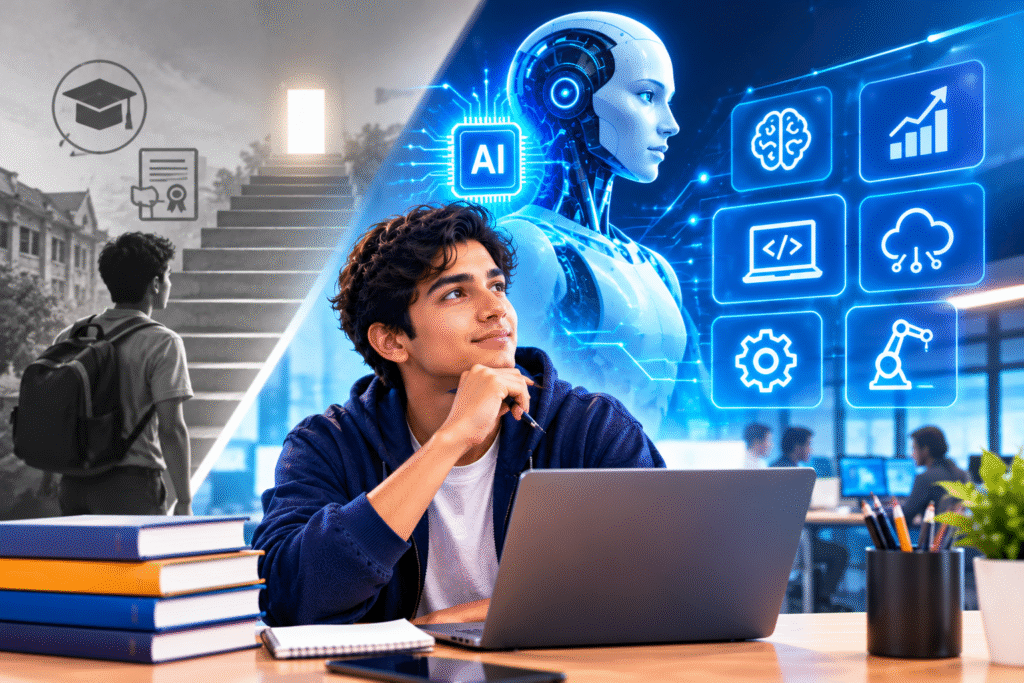
A few years ago, “will AI take my job?” was a speculative question asked at tech meetups. Today it comes up in college classrooms, hiring meetings and family conversations. The AI impact on IT jobs is no longer theoretical. Developers use AI assistants to write and debug code, testers use automation to generate test cases, and support teams rely on chatbots for first-line queries.
The honest answer is more nuanced than “AI will replace us” or “nothing will change.” AI is changing what IT work looks like, which skills carry value, and how people enter the field. This article explains what is happening in the IT job market, which roles are most exposed, where new opportunities are appearing, and how to prepare.
Why the AI Conversation Feels So Urgent in IT
Previous waves of automation mostly affected physical or repetitive clerical work. Generative AI is different because it handles tasks once considered distinctly “knowledge work”: writing code, summarising documents, drafting emails, producing designs and analysing data. IT professionals sit close to this technology, so they feel the change first.
Three shifts stand out:
- Productivity expectations are rising. When a tool can draft boilerplate code in seconds, employers expect more output from each person.
- Entry-level work is changing. Tasks that once trained freshers, such as writing simple scripts, basic test cases or documentation, can now be partly automated.
- Hiring is becoming more selective. Companies increasingly look for people who can think, design and verify, not just produce lines of code.
None of this means the sector is shrinking into irrelevance. It means the baseline for being “job-ready” has moved.
Which IT Roles Are Most Affected
The AI impact on IT jobs is uneven. Some tasks are easy to automate, while others still depend on human judgment, context and accountability.
Routine coding and maintenance. Generating standard functions, converting code between languages and writing repetitive CRUD logic are tasks AI tools now handle reasonably well. Developers who only perform this kind of work face the most pressure.
Manual testing and basic QA. Test case generation and regression testing are increasingly automated. Testers who understand automation frameworks, and who can judge whether a test is meaningful, remain valuable. Those who only execute scripted checks are more exposed.
First-level technical support. Chatbots and AI-driven ticket routing now resolve many common queries. Support roles are shifting toward complex troubleshooting and customer-specific problem solving.
Basic data entry and reporting. Dashboards that once took hours of manual work can now be built or refreshed with AI-assisted tools, so analysts are expected to deliver insight rather than raw tables.
“Affected” does not mean “eliminated.” In most cases the role changes shape: the repetitive part shrinks, and the judgment-heavy part grows. System architecture, security, debugging complex production issues, requirements gathering and stakeholder communication remain difficult to automate.
New Opportunities Created by AI
Every technology shift removes some tasks and creates others. The broader data supports this. The World Economic Forum’s Future of Jobs Report 2025 projects that 170 million new roles will be created and 92 million displaced by 2030, a net increase of 78 million jobs. You can read the full findings in the World Economic Forum’s Future of Jobs Report 2025. Inside IT, the IT job market is seeing growth in several areas: weforum
- AI and machine learning engineers who build, train and deploy models.
- Data scientists and analysts who turn growing volumes of data into decisions.
- Data engineers who build the pipelines that feed AI systems.
- Prompt and workflow designers who connect language models to real business processes.
- AI governance, risk and security specialists, since organisations must manage bias, privacy and misuse.
- MLOps and cloud engineers who keep AI systems running reliably at scale.
- Embedded and edge AI engineers who put intelligence inside devices such as vehicles, medical equipment and industrial sensors.
That last category is often overlooked. Not all AI lives in the cloud. Smart cameras, wearables, automotive systems and factory sensors increasingly run models directly on small, power-limited chips. Professionals who understand both hardware constraints and intelligent software are in a rare position, which is why training in embedded AI is becoming relevant for engineering graduates from electronics and IT backgrounds.
The Skills Employers Are Actually Looking For
If tools can generate code, what remains valuable? Mostly the things tools cannot reliably do on their own.
1. Strong fundamentals
AI can produce code, but someone must know whether it is correct, efficient and secure. Data structures, algorithms, databases, networking basics and clean design principles matter more now, not less. A developer who cannot read and critique generated code becomes a bottleneck rather than a multiplier.
2. Practical knowledge of machine learning
You do not need a research degree, but you do need to understand how models are trained, evaluated and deployed. In India, NASSCOM has reported that demand for highly qualified AI and big data analytics talent outstrips current supply, and stresses upskilling to narrow that gap. The details are in NASSCOM’s Talent Demand & Supply Report on AI and Big Data Analytics. Fluency in Python, statistics, data handling and machine learning lets you work with AI rather than be surprised by it. nasscom
3. Using generative AI well
Knowing how to use generative AI is quickly becoming a baseline expectation, similar to knowing a search engine or version control. That includes writing clear prompts, checking outputs for errors, protecting sensitive data and knowing when not to trust the result. The professionals who benefit most treat AI as a capable but fallible junior colleague: fast, useful and in need of review.
4. Full-stack versatility
Companies still need people who can build complete products, from interface to database to deployment. Full stack development remains one of the most employable skill sets because it combines problem solving, system thinking and delivery. The difference now is that full-stack developers who integrate AI features, such as recommendation engines, chat interfaces and automated workflows, stand out from those who do not.
5. Soft skills
Communication, collaboration, curiosity and the ability to learn quickly are often underestimated. As routine tasks are automated, the human parts of the job, such as explaining trade-offs, understanding a client’s real need and working across teams, become more visible and more valuable.
What Freshers and Career Switchers Should Do
The picture can feel discouraging to someone just starting out, but it is manageable with a practical plan.
Build real projects, not just certificates. Employers can see through a list of completed courses. A working application, a data analysis with real findings or a small embedded prototype demonstrates ability far better. Put your projects on GitHub and be ready to explain every design decision.
Learn one core language deeply. Python is a sensible first choice because it serves AI, data, automation and web development. Add SQL early, since almost every IT role touches data.
Pair your domain with AI literacy. A mechanical, electronics or commerce graduate who understands data and AI often has an advantage over a pure coder, because they bring industry context. Career switchers should lean on their prior experience rather than hide it.
Practice with AI tools, but understand the output. Use assistants to speed up learning and drafting, then make sure you can explain and modify what they produce. Interviewers increasingly test this exact ability.
Commit to continuous upskilling. The pace of change means no certification stays current forever. Reserve a few hours every week to learn a new tool, read documentation or rebuild an old project with a newer approach.
Choosing Training That Fits the New Reality
With so many courses available, selection matters. Look for programmes that offer practical, project-based learning rather than theory alone, internship exposure, interview preparation and honest guidance about outcomes. Be cautious of any institute that promises a guaranteed job, since results always depend on your own skills, effort and interview performance.
ISM UNIV, a skill-development institute based in Bangalore with more than three decades of training experience, offers programmes across embedded systems, data science, AI and machine learning, and full-stack development, with an emphasis on live projects, internships and placement assistance. Whichever institute you consider, attend a demo class, review the current syllabus and speak with former students before deciding.
Common Myths About AI and IT Careers
Myth: AI will make programmers obsolete. AI changes how software is written, but design, debugging, security, integration and accountability remain human responsibilities. Demand is shifting toward developers who can supervise and apply AI, not disappearing.
Myth: Only computer science graduates can work in AI. Many successful data and AI professionals come from electronics, mechanical, commerce, mathematics and science backgrounds. What matters is a willingness to learn programming, statistics and problem solving.
The AI impact on IT jobs is real, but it is neither a story of mass replacement nor of effortless opportunity. Repetitive tasks are being automated, expectations are rising, and entry-level paths are changing. At the same time, the IT job market is creating demand for people who can build, apply and govern intelligent systems.
The professionals who thrive will share a few habits. They master the fundamentals, use generative AI critically rather than blindly, build a portfolio that proves their skills, and treat learning as a permanent part of their career. If you are deciding where to invest your time, start with Python, add data and machine learning skills, and choose a specialisation that fits your interests, whether that is data, full stack development or embedded AI.
AI will not wait for anyone, but it also does not close the door on those who prepare. Every major technology shift has rewarded people who adapted early and kept learning. This one is no different. The best time to start building your skills is now, and the best way to start is with practical, hands-on guidance.
Start Your Journey with ISM UNIV
Ready to future-proof your IT career?
📞 Call: +91 9448474282
✉️ Email: learn@ismuniv.com
🌐 Website: https://ismuniv.com
ISM UNIV: Your Skills. Your Future. Job-Ready from Day 1.