
Beyond the Hard Drive: Where does the world's data actually live?
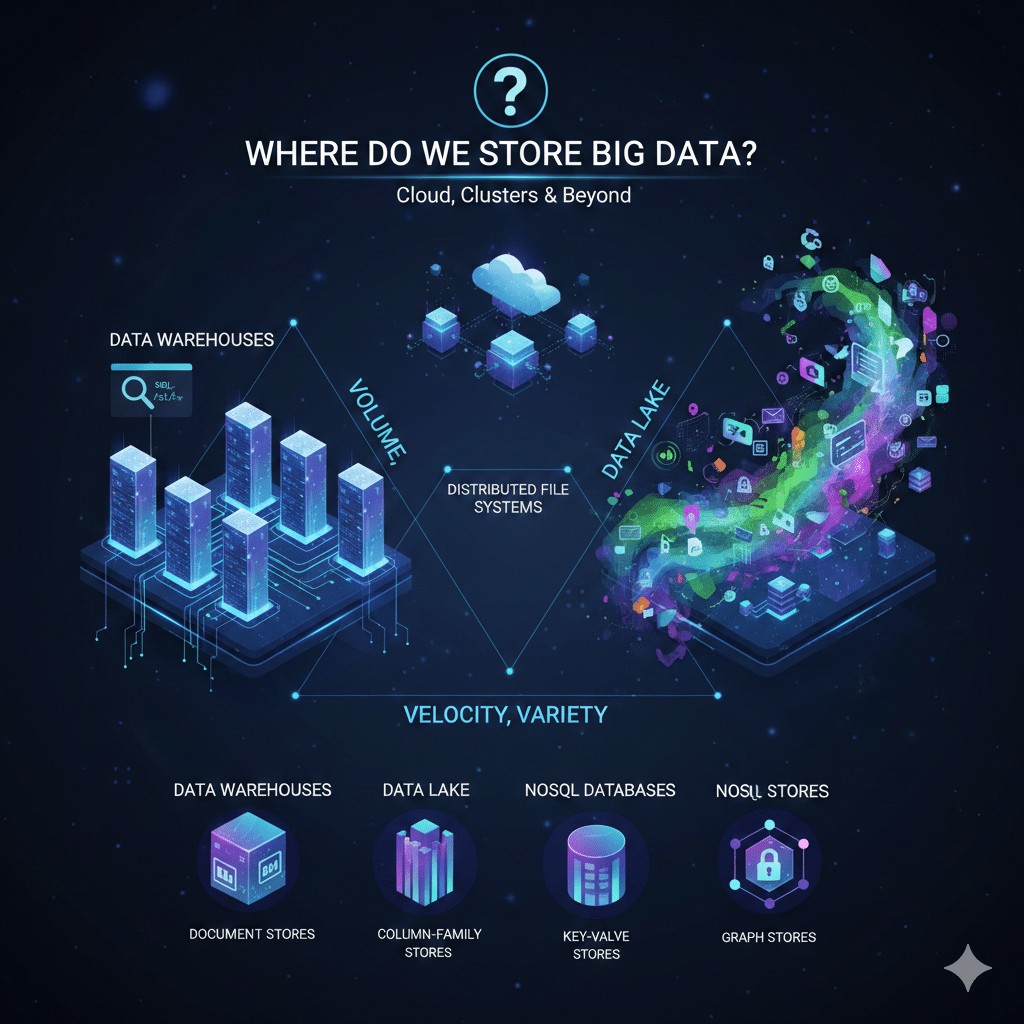
Where Do We Store Big Data?
Have you ever wondered what happens when you send a message, watch a video, or upload a photo on the internet? Where does all that information go? Does it just disappear, or is it stored somewhere? Now, before knowing about big data lets understand what is data.
What is Data?
- Data means any kind of information.
- It includes: Photos , videos , Emails , Online shopping details , Your location
- Everything you do on the internet creates data.
What is Big Data?
When data becomes very large and keeps increasing every second, it is called Big Data.
- Big Data is created by:
- Millions of people
- Mobile phones
- Websites
- Machines and sensors
Why is it important to store Big Data?
- Big Data helps in:
- Better medical treatment in hospitals
- Understanding customers in businesses
- Improving apps and websites
- If Big Data is not stored properly:
- Important information will be lost
- Companies and services will not work correctly
How big is Big Data?
Let’s play a game. Imagine you start typing on your keyboard and don’t stop for an entire year. You’d create maybe one gigabyte of text. Now imagine one million people doing the same thing. That’s closer to Big Data territory.
One petabyte – A Common Big Data Measurement Could Hold
- 500 billion pages of text
- 13 years of HD video
- The entire written works of humankind, from the beginning of recorded history, 50 times over
And companies deal with hundreds or thousands of petabytes! They simply can’t handle it. It’s like trying to fit an ocean in a bathtub……
Where is Big Data stored? – Can the big data be stored in normal computers!
NOOOOOO!!!!!!
The Old Way –
Data Centers
- Companies bought one huge, expensive storage machine
- Kept in special rooms with air conditioning
- Experts hired to maintain them
These kinds of methods or ways are good for small data but nut the large number of data , and these ways were too expensive, too slow, and simply couldn’t grow fast enough.
The modern ways –
- Cloud Storage
Big Data is Cloud Storage. Cloud storage means storing data on the internet instead of on your own computer. Companies like Google, Amazon, and Microsoft offer cloud services. Many businesses use cloud storage because it is cheaper, flexible, and easy to manage. If they need more space, they can simply increase their storage without buying new machines.
- Distributed Storage – (Many Small Boxes Working Together)
Let take an example to explain the concept of distributed storage like Instead of one giant safe, what if we used thousands of small boxes spread across many rooms? If one box breaks, no problem—we have copies in other boxes. Need more space? Just add more boxes.
Think of it like a puzzle. A huge picture is broken into thousands of small pieces, and each piece is stored in different locations. When you need the complete picture, a smart system quickly gathers all the pieces and shows you the whole image. This approach is cheaper
because those “boxes” are just regular computers, not expensive specialized machines.
Example: Hadoop system works exactly this way. It takes massive files, chops them into chunks, and spreads them across hundreds or thousands of ordinary computers. If one computer crashes, there are backup copies on other machines. It’s like having multiple spare keys to your house hidden in different place.
Types of Big Data Storage
- Hard Disk Drives (HDD): Used to store large amounts of data at Low cost
- Solid State Drives (SSD): Faster than HDD and Used when quick access is needed
- Tape Storage: Used to store old data and Very cheap and long-lasting
Is the big data kept safe????
Yes it’s kept safe and protected using:
- Password s, Encryption , Firewalls.
Only authorized people can access important data and Backup copies are also created so data is not lost .
Conclusion
- Big Data is created every second by people and machines.
- It is stored in:
- Data centers
- Cloud storage
- Distributed systems
- Proper storage helps:
- Hospitals treat patients
- Companies improve services
- Governments manage information
- Without storage, Big Data would be useless
🚀 Mastering the Future at ISM University of Skills
Understanding where we store Big Data is only half the battle; knowing how to manage, analyze, and secure it is where the real expertise lies. This is exactly what ISM University of Skills (ISM UNIV) has been doing for over 30 years.
As a pioneer in technical training, ISM UNIV bridges the gap between raw data and actionable intelligence. Whether you are looking to dive into the architecture of data storage or the algorithms that process it, they offer a curriculum designed for the modern industry.
📚 Featured Courses at ISM UNIV
If you’re interested in Big Data, AI, or Embedded Systems, check out these industry-leading programs:
Data Science with AI & ML: A deep dive into how we process massive datasets using Python, R, and advanced machine learning models.
Master in Embedded Systems and IoT (MESIOT): Learn how data is collected from the physical world through sensors and processed in real-time.
Big Data Certification: Specialized training in Hadoop administration and development—the backbone of distributed data storage.
Full Stack Development (Java/Python): Build the applications that interact with the Data Warehouses and Lakes we discussed above.
Why Choose ISM UNIV?
30+ Years of Excellence: Established in 1994, they are a trusted name in technical education.
Practical Learning: They emphasize hands-on projects and “Day-1” placement assistance.
Flexible Modes: Offering both online and offline classes in Bangalore and Hyderabad.
🔗 Explore all courses and start your journey here: www.ismuniv.com
General Surveys & Overviews
- “Big Data Storage: Key Components & Top 6 Storage Technologies” — overview of major big data storage types (HDFS, object stores, warehouses).
https://cloudian.com/guides/ai-infrastructure/big-data-storage-key-components-top-6-storage-technologies
- “A survey on data storage and placement methodologies for Cloud-Big Data ecosystem” — academic survey on big data storage strategies and placement issues.
https://journalofbigdata.springeropen.com/articles/10.1186/s40537-019-0178-3
- Springer chapter on Big Data Storage — state-of-the-art overview of technologies for handling velocity, variety and volume.
https://link.springer.com/chapter/10.1007/978-3-319-21569-3_7